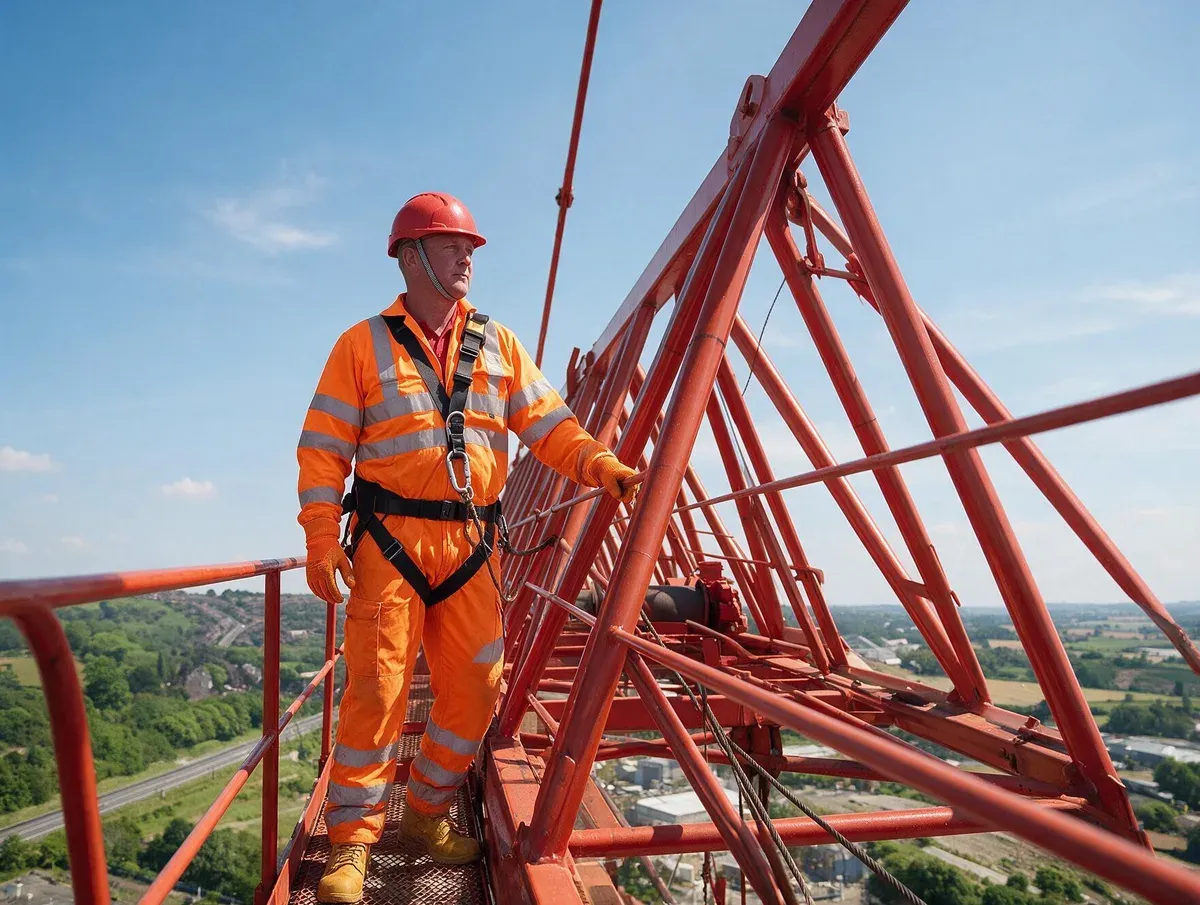
Quick answer: RIIWHS204E Work safely at heights is a nationally recognised unit of competency used in resources and infrastructure work. It is often called a “working at heights ticket”, although the formal result is normally a statement of attainment issued by an RTO after successful assessment. The unit is national, but workplace safety duties and refresher expectations must be checked for the relevant state or territory, employer, site and industry.
What is RIIWHS204E Work safely at heights?
RIIWHS204E Work safely at heights is a current unit of competency in the Resources and Infrastructure Industry Training Package.
It describes the skills and knowledge needed to prepare for work at heights, identify hazards and controls, use the required safety equipment, carry out the work and leave the work area in a safe condition. The unit is intended for operational roles where a person works under established procedures.
The national unit is not a complete set of instructions for every workplace. Its application section says licensing, legislative and certification requirements can vary between states, territories and industries. That is why a course decision should consider both the official unit and the rules applying to the intended work.
What the unit covers
The official unit is organised around four broad stages:
- identifying the work requirements, procedures and hazards
- selecting, fitting and checking the required equipment
- accessing and carrying out work at height safely
- clearing the work area and completing required records
Assessment is not only about remembering definitions. The performance evidence requires a learner to demonstrate work safely at heights on at least two occasions while applying the relevant procedures, controls and equipment.
What does “working at heights ticket” mean?
“Working at heights ticket” is common industry and search language, but it can create confusion.
RIIWHS204E is a unit of competency, not a separate national high risk work licence. When an RTO assesses a learner as competent, the learner normally receives a statement of attainment identifying the completed unit. Employers and sites may refer to that document, a wallet card supplied by an RTO or other evidence of training as a “ticket”.
Before enrolling, ask what nationally recognised outcome will be issued. The course information should identify RIIWHS204E, and the provider should be able to show that the unit is on its current training.gov.au scope.
Who may need a working at heights course?
The course is commonly considered by people working in construction, mining, resources, maintenance, utilities, warehousing and other roles where a fall from one level to another is possible.
Whether a particular worker needs RIIWHS204E is a separate question from whether the workplace has a fall risk. Training is one part of a safe system of work. A person conducting a business or undertaking—or an employer in Victoria—must still identify hazards, choose appropriate controls, provide safe access, maintain equipment and provide suitable information, training and supervision.
An employer, principal contractor or site may nominate RIIWHS204E as evidence of baseline competency. They may also require task-specific instruction, site induction, equipment familiarisation, rescue training or supervision.
Course delivery, practical assessment and evidence
A work safely at heights course should give learners a meaningful opportunity to practise the procedures and equipment they will be assessed on.
The official assessment requirements include access to workplace instructions and safety information, personal protective equipment, fall-protection equipment and realistic tasks. Assessment must cover practical work on at least two occasions. It also checks that the learner can interpret information, identify hazards, apply controls, inspect equipment and respond to changing conditions.
This practical evidence matters when considering online advertising. Theory may be supported online, but the provider must still explain how the required practical training and assessment will occur.
Useful questions for an RTO include:
- Where does practical training take place?
- Which fall-prevention, restraint or arrest systems will be used?
- How many learners are in each practical group?
- What identification and personal protective equipment should I bring?
- How is prior experience considered?
- What happens if more training is needed before assessment?
- Which nationally recognised document is issued after a competent result?
How long is a working at heights course?
There is no single national course duration printed in the unit itself.
An RTO sets its course structure and scheduled duration after considering the training product, the learner cohort, delivery method, facilities and assessment requirements. An experienced worker completing a structured program may have different learning needs from someone using fall-protection equipment for the first time.
Rather than choosing a course only because it is short, confirm that the delivery includes the practical learning and assessment required for RIIWHS204E.
The national unit does not list prerequisite units. An RTO can still set reasonable entry arrangements, such as language, literacy, numeracy, physical-capacity, identification or site requirements. Employers may also expect a construction induction card or other role-specific training for the work itself.
How long does Work safely at heights last?
The RIIWHS204E national unit does not state that the resulting statement of attainment expires after one fixed period.
That does not mean a person should assume their competency will always be accepted without review. An employer, project, mine site, principal contractor, client or industry procedure may specify a refresher interval or require recent evidence. Refresher training may also be appropriate when:
- the person has not performed the task for a significant period
- equipment, work methods or legislation have changed
- an incident or observation identifies a skills gap
- the worker cannot demonstrate current competence
- a site or contract sets a currency requirement
Ask the organisation requiring the training what evidence and currency period it accepts. Be cautious of claims that every working at heights ticket automatically expires after the same number of years across Australia.
Training does not replace fall-risk controls
Safe Work Australia’s model code explains how to manage a risk of a person falling from one level to another where injury is reasonably likely.
The preferred approach is to eliminate the need to work at height where reasonably practicable. If that is not possible, duty holders work through higher-order controls before relying on lower-order measures.
A simplified sequence is:
- do the work on the ground or from a solid construction
- use a fall-prevention device such as scaffolding, guardrails or a suitable work platform
- use a work-positioning system where higher controls are not reasonably practicable
- use a fall-arrest system where the risk cannot be controlled by the earlier measures
- support the system with procedures, information, training, supervision and suitable PPE
Training is essential when people use these systems, but a certificate does not make an uncontrolled work area safe.
Working at heights requirements by state and territory
Safe Work Australia develops model WHS laws and guidance, but it is not the workplace regulator. States and territories regulate and enforce their own laws. Victoria uses occupational health and safety legislation rather than the model WHS terminology.
The national unit is the same across Australia, but the law, regulator guidance, employer procedures and site rules must be checked locally. Use this overview to choose the detailed guide for the place where the work will happen:
- New South Wales: SafeWork NSW guidance, fall-risk controls, construction SWMS requirements and Sydney course checks.
- Victoria: WorkSafe Victoria’s fall-prevention hierarchy, Victorian OHS duties, SWMS requirements and Melbourne course checks.
- Queensland: WorkSafe Queensland fall controls, construction SWMS requirements and Brisbane or Gold Coast course checks.
- Western Australia: WorkSafe WA requirements, time-sensitive 2026 transition arrangements and Perth course checks.
- South Australia: SafeWork SA fall controls, current construction SWMS requirements and Adelaide course checks.
- Tasmania: Tasmania’s approved falls code, workplace controls and Hobart course checks.
- Australian Capital Territory: WorkSafe ACT guidance, high-risk construction requirements and Canberra course checks.
- Northern Territory: NT WorkSafe’s approved falls code, workplace controls and Darwin course checks.
Each jurisdiction guide explains the local regulator and course-enquiry checks without claiming that a provider is available in a particular city. Always confirm current requirements with the regulator, employer and work site.
How to choose and verify an RTO
Before booking a working at heights course:
- search the provider on training.gov.au
- confirm that the RTO’s registration is current
- check that RIIWHS204E is on its current scope
- confirm the delivery location and practical assessment arrangements
- ask about the full fee and what it includes
- confirm identification, clothing, PPE and entry requirements
- ask what document will be issued after successful assessment
- check any employer, project or site currency requirement
Training Connect’s RIIWHS204E page lets you review the unit, compare the listed provider information and send an enquiry about timing, group size and location.