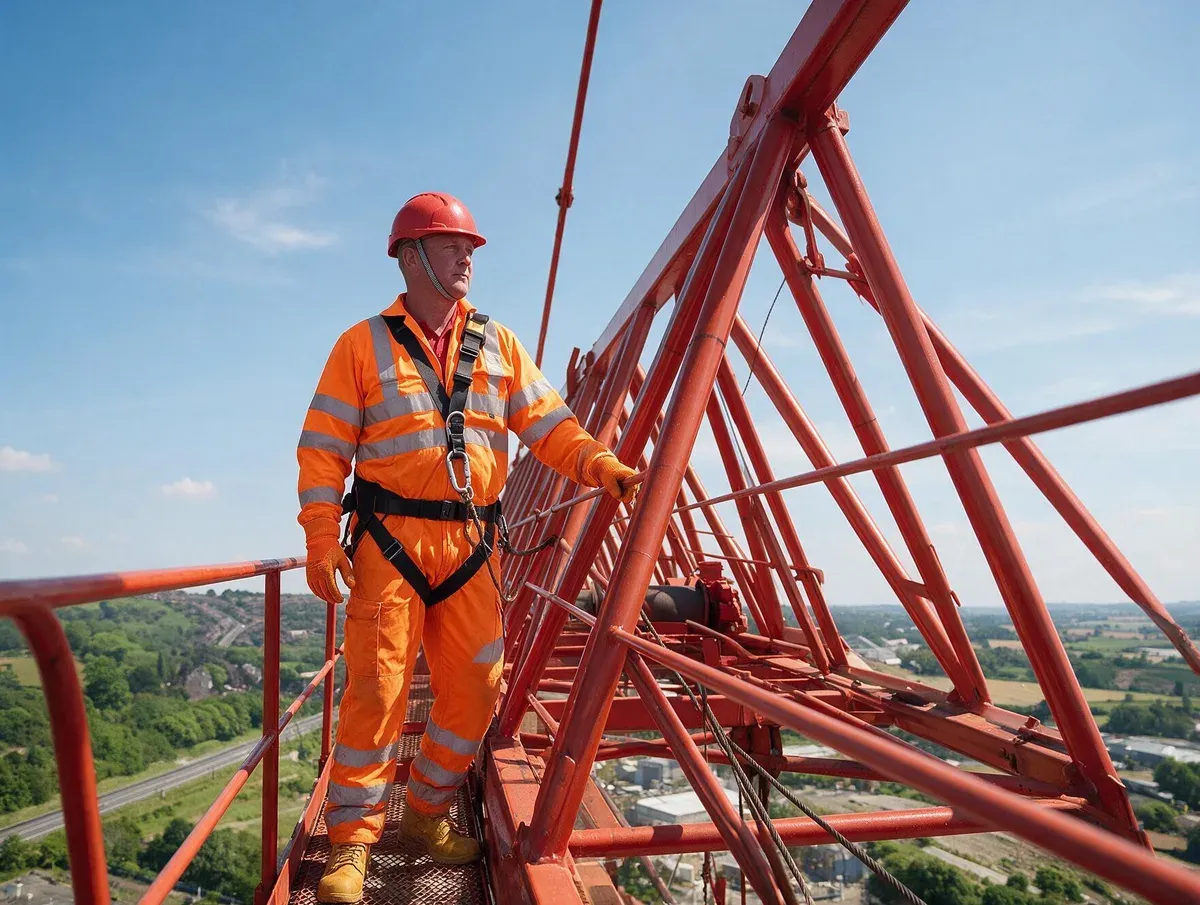
Quick answer: RIIWHS204E is the same national unit in Victoria as elsewhere in Australia, but Victorian work is regulated under the state’s Occupational Health and Safety framework. WorkSafe Victoria applies specific fall-prevention duties above two metres, while an employer’s broader duty to provide a safe working environment also applies to lower falls.
What is the RIIWHS204E course in Victoria?
RIIWHS204E Work safely at heights covers the skills and knowledge needed to prepare for work at heights, identify hazards, select and check equipment, perform the work and complete the task safely.
It is a unit of competency rather than a Victorian licence. After a competent assessment result, the RTO normally issues a statement of attainment. “Working at heights ticket” is informal language commonly used for this evidence.
The unit does not replace Victorian legal duties or workplace procedures. Employers still need to provide safe systems, suitable equipment, information, instruction, training and supervision.
Victoria uses OHS legislation
Victoria operates under the Occupational Health and Safety Act 2004 and Occupational Health and Safety Regulations 2017 rather than the model WHS laws used in most other Australian jurisdictions.
WorkSafe Victoria says Part 3.3 of the OHS Regulations applies where there is a risk of a fall of more than two metres. The regulator also states that employers have a duty under the OHS Act to provide and maintain a working environment that is safe and without risks to health so far as reasonably practicable.
That general duty matters below two metres. A lower fall can still cause fractures, head injuries or other serious harm, so the two-metre threshold should not be treated as a general definition of safe work.
Victoria’s hierarchy for preventing falls
WorkSafe Victoria’s fall-prevention material places eliminating the risk first. Where reasonably practicable, work should be completed on the ground or from a solid construction.
When the risk cannot be eliminated, the control sequence for work above two metres moves through:
- passive fall-prevention devices such as scaffolds, guardrails, safety mesh or suitable work platforms
- work-positioning systems
- fall-arrest systems
- administrative controls or ladders where higher controls are not reasonably practicable
The selected system needs to suit the task and remain effective. Training a worker to use a harness does not by itself justify bypassing a reasonably practicable higher-order control.
SWMS requirements for Victorian construction work
WorkSafe Victoria’s SWMS guidance says construction work with a risk of a person falling more than two metres is high-risk construction work.
Employers and self-employed persons must prepare a safe work method statement before high-risk construction work starts. The SWMS sets out the work, hazards and risks, and the measures used to control them. The work must then be carried out in accordance with the SWMS.
A SWMS is not the same as a general risk assessment or job safety analysis. Other hazards still need to be managed even when they are not one of the prescribed high-risk construction categories.
Course evidence and refresher expectations in Victoria
RIIWHS204E does not prescribe one statewide expiry date.
An employer, principal contractor, site or industry procedure may require a refresher interval or recent evidence. Currency may be reviewed after a long break from the task, a change in equipment or procedures, an incident, or an observation that the worker cannot demonstrate current competence.
Ask the organisation requiring the training what it accepts before enrolling in a refresher. A statement of attainment, RTO-supplied card and site competency record may serve different purposes.
Working at heights courses in Melbourne and regional Victoria
The national unit is unchanged between Melbourne, Geelong, Ballarat and regional Victoria. Provider scope and delivery arrangements still need to be verified.
When enquiring about a working at heights course in Melbourne or elsewhere in Victoria, ask for:
- the RTO’s legal name and registration code
- confirmation that RIIWHS204E is on its current scope
- the exact venue and scheduled date
- practical training and assessment arrangements
- the equipment learners will use
- fees, identification, clothing and PPE requirements
- the nationally recognised document issued after assessment
Training Connect does not treat a provider’s national scope as proof of a Melbourne delivery location. Confirm the venue and current availability directly with the RTO.
How to verify a Victorian RTO
Use training.gov.au to check that the provider’s registration is current and RIIWHS204E appears on its scope. Match the RTO code in the advertisement or enrolment material to the official record.
Ask how the course will satisfy the practical performance evidence. The official unit requires work-at-heights performance on at least two occasions, so a provider advertising online study should explain the supervised practical component.
The national working at heights guide covers broader questions about course duration, prerequisites, assessment and whether a working at heights statement of attainment expires.