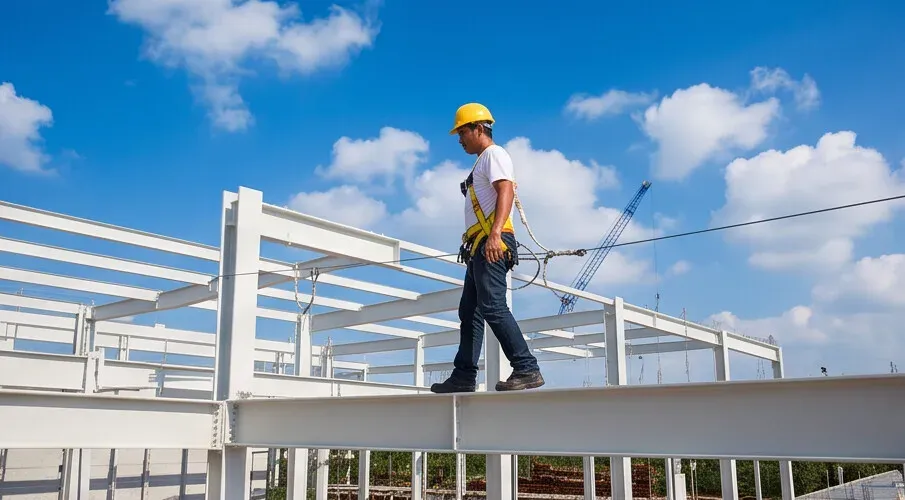
Quick answer: A working at heights course in NSW may deliver the national RIIWHS204E Work safely at heights unit, but the training outcome is only one part of safe work. NSW employers and other duty holders must manage fall risks at any height, and construction work with a risk of a fall greater than two metres has specific high-risk construction and SWMS requirements.
What is the RIIWHS204E course in NSW?
RIIWHS204E Work safely at heights is a nationally recognised unit of competency in the Resources and Infrastructure Industry Training Package. The unit covers preparing for work at heights, identifying hazards and controls, selecting and checking equipment, carrying out the work and clearing the work area.
The unit is national rather than NSW-specific. A person assessed as competent will normally receive a statement of attainment from the Registered Training Organisation (RTO). People often call this evidence a “working at heights ticket”, but it is not a separate national high risk work licence.
NSW workplace rules still apply to work performed in the state. Training does not replace a site risk assessment, safe access, suitable fall controls, equipment inspection, supervision or task-specific procedures.
NSW fall-risk duties apply at any height
SafeWork NSW says employers must protect workers from the risk of falling from one level to another regardless of the height.
Its construction guidance starts with avoiding work at height where possible. When that is not reasonably practicable, the regulator describes a control sequence that favours:
- working from the ground or a solid construction
- preventing a fall with a suitable device such as scaffolding, edge protection or a work platform
- using a work-positioning system where fall prevention is not reasonably practicable
- using a fall-arrest system when the higher controls cannot be used
Information, instruction, training, supervision and personal protective equipment support those controls. They do not replace higher-order physical controls where those controls are reasonably practicable.
When a SWMS is required in NSW
SafeWork NSW states that a safe work method statement (SWMS) is required for construction work where a person could fall more than two metres.
The SWMS should be site-specific and describe the high-risk construction work, hazards, control measures and how the controls will be implemented. Workers need to understand and follow it.
The two-metre figure relates to the high-risk construction and SWMS framework. It does not mean a fall below two metres is safe. Open penetrations, unstable surfaces, plant, sharp objects and lower-level edges can create serious risks that still need to be controlled.
Course evidence and currency in NSW
The national RIIWHS204E unit does not specify one expiry date for every statement of attainment.
An NSW employer, principal contractor, mine, infrastructure project or individual work site may set its own evidence and currency expectations. Refresher training or reassessment may be requested where work has not been performed recently, equipment or procedures have changed, a skills gap is identified or a contract specifies a currency period.
Before booking, ask the organisation requiring the training:
- whether it requires RIIWHS204E specifically
- whether it accepts an older statement of attainment
- whether it requires a refresher or site-specific practical verification
- which induction, equipment or rescue competencies are also required
Working at heights courses in Sydney and regional NSW
The national unit code does not change between Sydney, Newcastle, Wollongong and regional NSW. What changes is the provider, venue, schedule and workplace context.
When looking for a working at heights course in Sydney or elsewhere in NSW, confirm:
- the RTO’s registration is current
- RIIWHS204E appears on its current training.gov.au scope
- the exact venue and course date
- how practical training and assessment will be completed
- the equipment and facilities learners will use
- the full fee, identification requirements and expected clothing or PPE
- the document issued after successful assessment
Training Connect does not infer NSW or Sydney availability from an RTO’s national registration. Use the course enquiry to ask a listed provider to confirm the location and current arrangements.
How to verify a NSW course provider
Search the RTO on training.gov.au and check both its registration status and scope. A business name, advertisement or wallet card is not enough on its own to establish that nationally recognised RIIWHS204E training can be delivered.
The RTO should also explain how its practical assessment meets the official unit requirements. RIIWHS204E requires practical performance evidence on at least two occasions, so ask how any online or blended component connects to supervised practical assessment.
Review the national working at heights guide for course duration, assessment, ticket terminology and validity questions that apply across Australia.