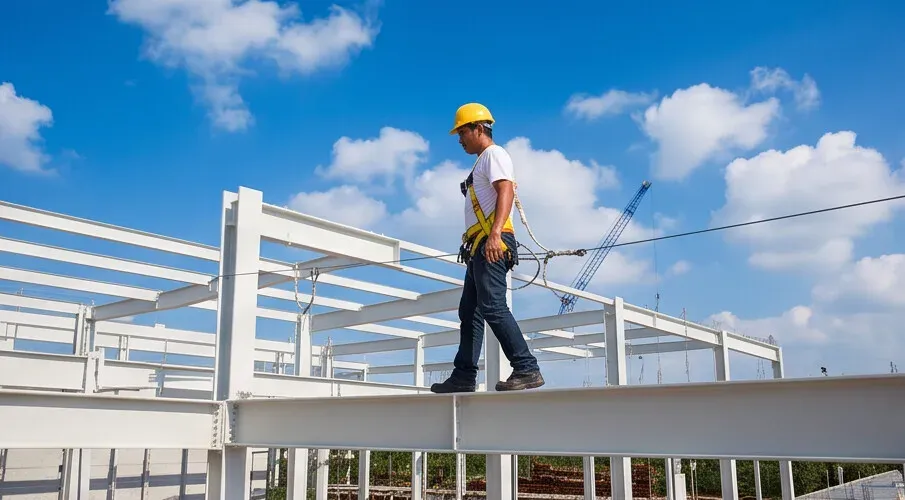
Quick answer: A working at heights course in Queensland may deliver the national RIIWHS204E unit. Queensland’s Work Health and Safety Regulation and regulator guidance separately determine how fall risks must be managed at work, including additional controls and SWMS duties for construction.
What is the RIIWHS204E course in Queensland?
RIIWHS204E Work safely at heights is a national unit covering preparation, hazard identification, fall controls, equipment checks, safe work and completion of the task.
The unit is not a separate Queensland licence. An RTO normally issues a statement of attainment after a learner is assessed as competent. A provider or employer may also use the informal term “working at heights ticket”.
The training outcome does not replace a Queensland employer’s or PCBU’s duties. Work must still follow the risk controls, access arrangements, equipment requirements, supervision and site procedures applying to the task.
Queensland fall-risk duties and controls
WorkSafe Queensland points to Part 4.4 of the Work Health and Safety Regulation 2011 and the Managing the risk of falls at workplaces Code of Practice 2021.
The regulator says a PCBU must manage the risk of workers falling from one level to another. Its guidance uses the hierarchy of control:
- eliminate the need to work at height where reasonably practicable
- work from a solid construction
- provide and maintain a safe system of work
- prefer a fall-prevention device, then a work-positioning system, then a fall-arrest system where higher controls are not reasonably practicable
Administrative controls, training and PPE are generally not enough on their own. They normally support higher-order measures.
Queensland construction thresholds are task-specific
Queensland’s construction provisions distinguish between different fall distances and types of work.
WorkSafe Queensland explains that section 306C addresses:
- fall risks below three metres in housing construction
- fall risks below two metres in other construction work
- construction work on a roof with a slope not over 26 degrees
Those conditions still require hazards to be identified, assessed and controlled before work starts.
Section 306D addresses higher fall risks and steeper roofs, with specified measures to prevent or arrest a fall. The applicable control can depend on the distance, roof slope, task and what is reasonably practicable.
This is one reason not to reduce Queensland working-at-heights safety to a single universal height rule.
SWMS requirements in Queensland
WorkSafe Queensland states that a safe work method statement is required for construction work where there is a risk of a person falling more than two metres.
The SWMS must address the high-risk construction work and the control measures used. Other fall risks can still require controls even when the SWMS threshold is not reached.
For example, an edge, opening, unstable surface or object below the work may make a shorter fall dangerous. The assessment needs to consider the actual situation rather than only the measured distance.
Course currency and refresher expectations in Queensland
RIIWHS204E does not set a single Queensland expiry date.
Employers, construction projects, resources sites and clients may require a recent statement of attainment, periodic refresher training or site verification. A review may also be appropriate where equipment or procedures change, the worker has not performed the task recently, or supervision identifies a gap.
Before booking, ask the organisation requiring the evidence:
- which unit or competency it requires
- whether it sets a currency period
- whether it requires site-specific verification or induction
- whether other rescue, plant or access training is needed
Courses in Brisbane, the Gold Coast and regional Queensland
RIIWHS204E is the same national unit in Brisbane, the Gold Coast and regional Queensland. Course schedules and locations are provider-specific.
When enquiring, confirm:
- the provider is a current RTO
- RIIWHS204E appears on its training.gov.au scope
- the exact training venue and date
- how the practical activities and assessment are delivered
- the equipment and facilities available
- the total fee and any identification, clothing or PPE requirements
- the evidence issued after a competent result
Training Connect does not infer Brisbane or Gold Coast availability from an RTO’s scope. Ask the provider to confirm the current venue, delivery mode and places before making arrangements.
How to verify a Queensland course provider
Check the official RTO record and scope on training.gov.au. Match the provider’s legal identity and registration code with its advertising and enrolment information.
The official unit requires practical performance on at least two occasions. If a course is advertised as online or blended, ask where the supervised practical training and assessment take place.
For general questions about course duration, assessment, ticket terminology and national validity, use the Australia working at heights course guide.